

Choosing the right mini split for your home isn’t just about finding a system with the right BTU capacity. The right system should match your space, comfort needs, climate, and the number of areas you want to heat and cool.
With different BTU capacities, efficiency ratings, single- and multi-zone configurations, and models designed for different operating conditions, knowing where to start can feel overwhelming. Exploring Senville’s mini split systems can give you a better idea of the available configurations before narrowing down your options.
Fortunately, narrowing down your options becomes much easier when you know what to look for.
In this guide, we’ll walk through the key factors to consider when choosing a mini split for your Canadian home - from sizing and zoning to efficiency, climate performance, and installation.
What You'll Learn
How to determine your home's heating and cooling needs
Why proper BTU sizing matters
When to choose single-zone vs. multi-zone
What to consider for colder Canadian climates
How efficiency ratings can help you compare systems
Why professional installation and proper sizing matter
1. Start With the Space You Want to Heat and Cool
Before comparing models, think about where you actually need comfort.
Are you trying to condition:
- One bedroom?
- A basement?
- An open-concept living area?
- A garage or workshop?
- Several bedrooms?
- Multiple floors?
- Most of your home?
This is important because a mini split designed for one room may look very different from a system intended to serve several areas.
A single-zone mini split connects one indoor unit to one outdoor unit. A multi-zone system connects multiple indoor units to a single outdoor unit, allowing you to condition several areas independently.
Not sure where to begin? You can also browse mini splits by room size as a starting point before determining the specific heating and cooling requirements of your space.
Quick Tip
Think in zones, not just square footage. Bedrooms, basements, additions, and open living areas can all have different comfort needs, even within the same home.
2. Determine the Right BTU Capacity
Once you know which space you want to condition, the next step is determining the heating and cooling capacity required.
Mini split capacity is commonly expressed in BTUs (British Thermal Units). You’ll frequently see systems offered in capacities such as 9,000, 12,000, 18,000, and 24,000 BTU.
It can be tempting to assume that a larger system is automatically better. That’s not necessarily the case.
An appropriately sized system is important for maintaining comfort and efficient operation. A system that’s not properly matched to the space may not perform as intended.
| Factor | Why It Matters |
|---|---|
| Room size | Larger spaces generally require greater capacity |
| Ceiling height | Higher ceilings increase the volume of air being conditioned |
| Insulation | Insulation affects how quickly your home gains or loses heat |
| Windows | Size, quantity, orientation, and efficiency can affect heating and cooling loads |
| Sun exposure | Rooms with significant direct sunlight may have different cooling requirements |
| Home layout | Open and divided spaces distribute conditioned air differently |
| Canadian climate | Local outdoor temperatures affect heating requirements |
Once you have a better understanding of your home's requirements, you can browse Senville systems by BTU to compare available capacities.
Did You Know?
Square footage is only a starting point. Proper HVAC sizing also considers ceiling height, insulation, windows, climate, construction, and other characteristics of your home.
3. Decide Between Single-Zone and Multi-Zone
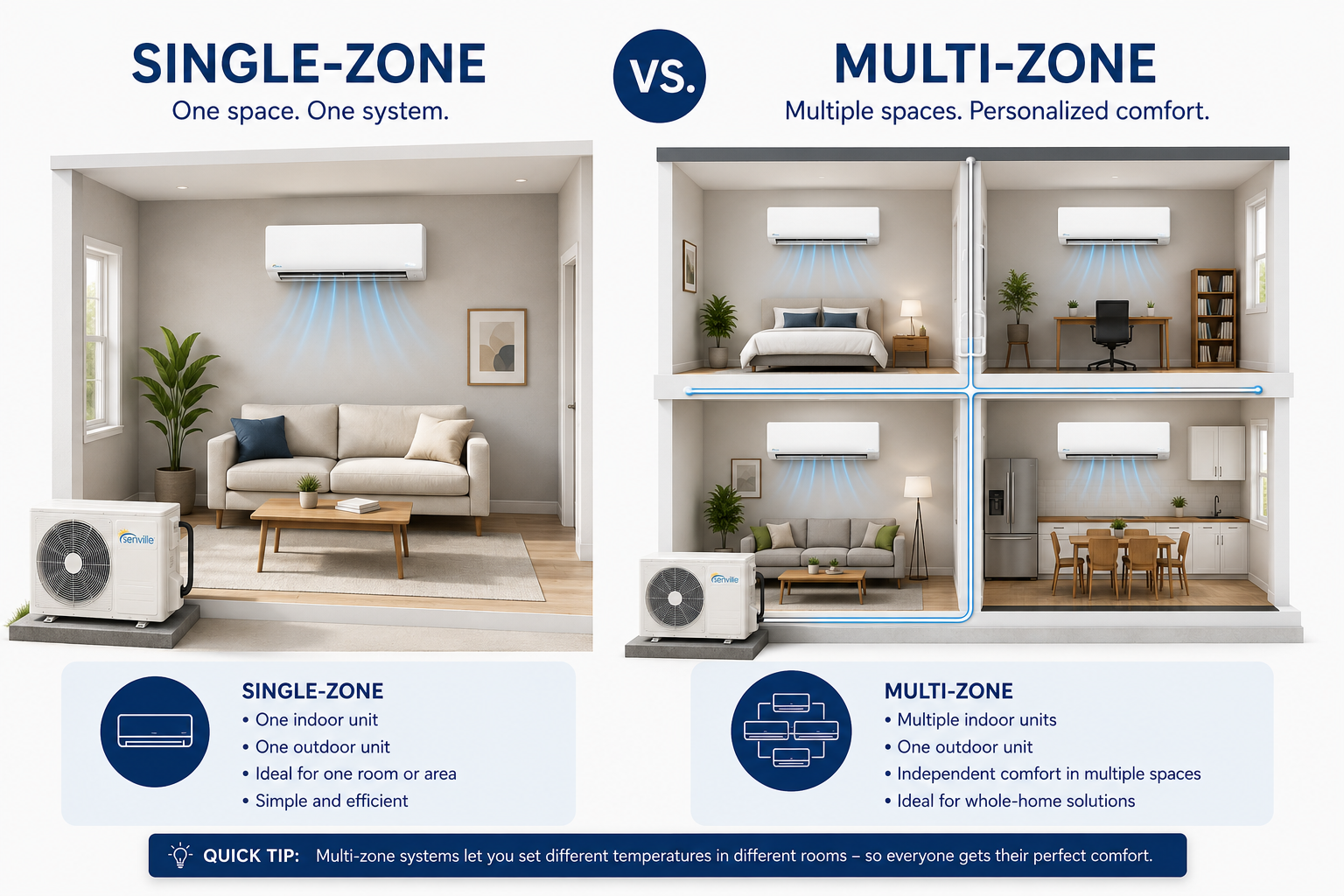
Single-Zone Mini Split
A single-zone system consists of one outdoor unit connected to one indoor unit.
It can be a practical choice for:
- Bedrooms
- Basements
- Home offices
- Garages or workshops
- Additions
- Open living areas
- Individual problem rooms
Multi-Zone Mini Split
A multi-zone system allows multiple indoor units to connect to one outdoor unit.
This can make sense when you want independent comfort across several rooms or areas of your home.
Which One Fits Your Home?
Consider single-zone if: You're primarily trying to improve comfort in one room or area.
Consider multi-zone if: Several areas of your home have different heating and cooling needs.
4. Consider Canada’s Climate
For Canadian homeowners, heating performance deserves particular attention.
Not every mini split is designed for the same outdoor temperature range. If you plan to rely heavily on your heat pump during winter, check the minimum outdoor operating temperature and heating specifications for the exact model you’re considering.
Cold-climate systems are specifically designed to continue providing heat at lower outdoor temperatures.
For example, the Senville Aura Series heats down to -30°C (-22°F). Always verify the specifications of the individual model because capabilities can differ by capacity and series.
Canadian Homeowner Tip
If winter heating is a major reason you're purchasing a mini split, don't compare systems based on cooling efficiency alone. Review cold-weather heating performance, efficiency, capacity, and the manufacturer's specified operating range.
5. Compare Efficiency Ratings
Once you’ve narrowed down the appropriate type and capacity, efficiency can help differentiate your options.
Two ratings you’ll commonly encounter are:
SEER2
SEER2 measures seasonal cooling efficiency. Generally, a higher rating indicates greater cooling efficiency under the rating procedure.
HSPF2
HSPF2 is used to evaluate seasonal heating efficiency.
For Canadian homeowners planning to use a heat pump extensively during winter, it’s worth considering both cooling and heating performance rather than focusing on a single efficiency number.
Senville models vary considerably by series and capacity. For example, the current 12,000 BTU LETO has a SEER2 of 21.2, while the 12,000 BTU Elite has a 29.4 SEER2. Specifications should always be compared for the exact models you’re considering.
Quick Tip
Don’t choose a mini split based on one efficiency rating alone. The best fit should balance capacity, climate performance, zoning needs, features, and efficiency for your home.
6. Compare the Series and Features That Matter to You
Once you’ve established the fundamentals, you can start comparing specific systems.
Rather than simply asking “Which mini split is best?”, ask:
“Which mini split best fits how I plan to use it?”
| Your Priority | What to Look For |
|---|---|
| Everyday heating + cooling | Appropriate capacity and balanced features |
| Cold Canadian winters | Low-temperature heating capability |
| Maximum efficiency | Higher efficiency ratings |
| Several rooms | Multi-zone compatibility |
| Bedroom comfort | Quiet indoor operation |
| Smart-home convenience | Wi-Fi or smart-control compatibility |
Product Comparison Tip
When comparing Senville systems, review the technical specifications on the individual product page rather than assuming every capacity within a series has identical efficiency ratings or operating ranges.
7. Think About Indoor Unit Placement
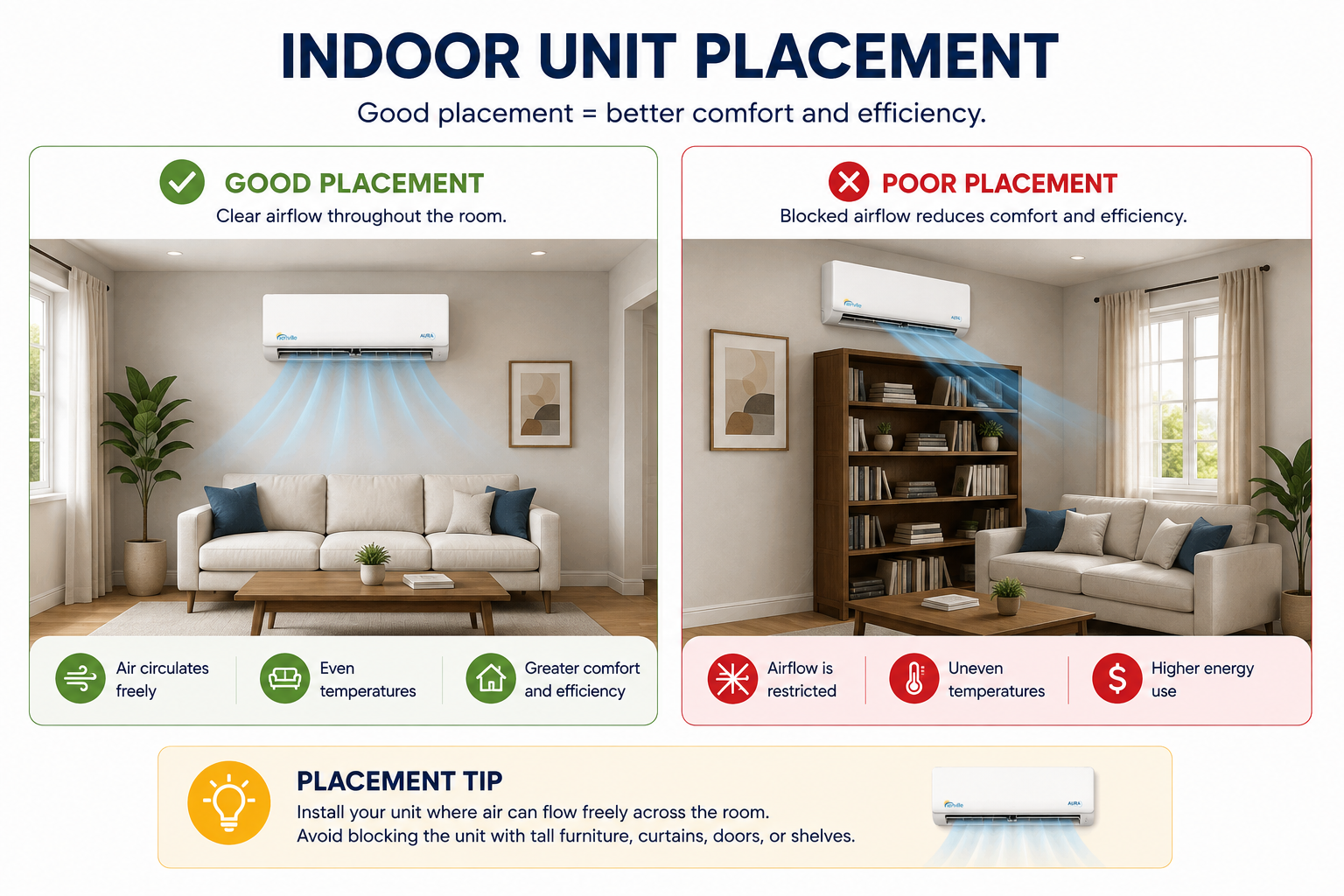
Choosing the system is only part of the equation. Where the indoor unit is installed can also affect comfort and airflow.
A wall-mounted indoor unit needs sufficient space to distribute conditioned air effectively.
Depending on your space and installation requirements, you may also want to consider alternatives to a traditional wall-mounted indoor unit, including ceiling cassette, concealed duct or floor-mounted configurations.
Avoid choosing a location where airflow will be unnecessarily obstructed by:
- Tall furniture
- Curtains
- Shelving
- Doors
- Large fixtures
The best location will depend on the room, system and installation requirements.
8. Plan for Professional Installation
Mini split installation involves refrigerant piping, electrical connections, condensate drainage, pressure testing, evacuation and system commissioning.
Pressure testing and evacuation of line sets must be completed by a licensed HVAC professional to ensure warranty validity.
Proper installation also helps ensure the system operates according to its intended specifications.
Before installation, discuss:
- System sizing
- Indoor and outdoor unit placement
- Electrical requirements
- Line-set routing
- Condensate drainage
- Local codes and permits
- System commissioning
IMPORTANT
Always check the installation manual and warranty requirements for the specific system you’re purchasing.
Mini Split Buying Checklist
How many rooms or areas do I want to heat and cool?
Do I need a single-zone or multi-zone system?
Has the required heating and cooling load been properly assessed?
How important is cold-weather heating performance?
Have I compared both heating and cooling efficiency?
Are quiet operation or smart controls important to me?
Have I checked the specifications for the exact model?
Have I planned for professional installation?
Frequently Asked Questions About Choosing a Mini Split
Still deciding which system is right for your home? Here are answers to some of the most common questions homeowners ask when comparing mini split systems.
What size mini split do I need?
The correct capacity depends on more than square footage. Room dimensions are a useful starting point, but ceiling height, insulation, windows, climate, sun exposure, and other factors can affect heating and cooling requirements. A professional load calculation is the best way to determine the appropriate capacity for your home.
Is a bigger mini split better?
Not necessarily. HVAC equipment should be appropriately sized for the space and its heating and cooling load. Choosing a larger unit simply because it has more capacity isn't a substitute for proper sizing.
Should I choose a single-zone or multi-zone mini split?
If you primarily want to condition one area, a single-zone system may be appropriate. If several rooms have different comfort needs, a multi-zone system can provide independent temperature control across multiple zones using one outdoor unit.
What should Canadians look for when choosing a heat pump?
In addition to sizing and efficiency, Canadian homeowners should pay particular attention to low-temperature heating performance. Check the manufacturer's minimum operating temperature and heating specifications for the exact model you're considering.
Do mini splits need professional installation?
To maintain your Senville warranty, we require the line sets to be pressure tested and evacuated by a licensed HVAC professional. Installation may also involve electrical connections, refrigerant piping, condensate drainage, and local code requirements, so we recommend reviewing the installation and warranty guidelines for your specific model before getting started.
Find the Right Comfort Solution for Your Home
There’s no single mini split that’s right for every home.
The best choice depends on your space, climate, comfort priorities and how you plan to use the system. Start by determining how many areas you want to condition, make sure the system is properly sized, compare cold-weather and efficiency specifications, and then narrow your choices based on the features that matter most.
Ready to find the right mini split for your home? Browse Senville mini split systems to compare capacities, features and configurations designed for Canadian homes.