
Should I Leave My Heat Pump On All the Time? A Canadian Homeowner's Guide
If you've always turned down the thermostat before bed or switched off the heat when leaving for work, you might wonder whether you should do the same with your heat pump.
For many Canadian homeowners, the answer is a little different from what they're used to.
Unlike traditional heating systems that frequently cycle on and off, modern ductless heat pumps use inverter technology to adjust their output as your home's heating needs change.
That means keeping your heat pump running at a consistent temperature can often be a practical way to maintain comfort, especially during a Canadian winter.
But does that mean you should leave your mini split on 24/7, even when you're sleeping or away from home?
Here's what you need to know.
Quick Answer: Should I Leave My Heat Pump On All the Time?
In most cases, yes. During the heating season, leaving your ductless heat pump running at a consistent temperature is generally a good approach.
Inverter-driven mini splits are designed to adjust their heating output rather than constantly operate at full capacity. Maintaining a steady temperature can help avoid long recovery periods, especially during cold Canadian winters.
If you prefer a cooler home overnight or while you're at work, consider a small temperature setback of approximately 1–2°C instead of switching the system off completely.
You can turn your heat pump off when heating or cooling isn't needed, such as during mild spring or fall weather. However, avoid switching off your home's necessary heating during freezing conditions.
The best approach depends on your heat pump model, home insulation, local climate, and whether you use supplemental heating.
What You'll Learn
- Why inverter heat pumps are designed for extended operation
- Whether leaving your heat pump on increases electricity costs
- When to leave it running, lower the temperature, or turn it off
- How to adjust your heat pump overnight or while you're at work
- Recommended heating and cooling settings
- What to consider during extreme Canadian winter temperatures
- When turning your heat pump off makes sense
1. Why Are Heat Pumps Designed to Run for Long Periods?
One of the biggest differences between a modern ductless heat pump and a traditional heating system is how it controls its output.
Senville ductless mini split heat pumps use inverter compressor technology.
Instead of operating at only one speed, the compressor adjusts its speed to match the heating or cooling needs of the space.
How Does Inverter Technology Work?
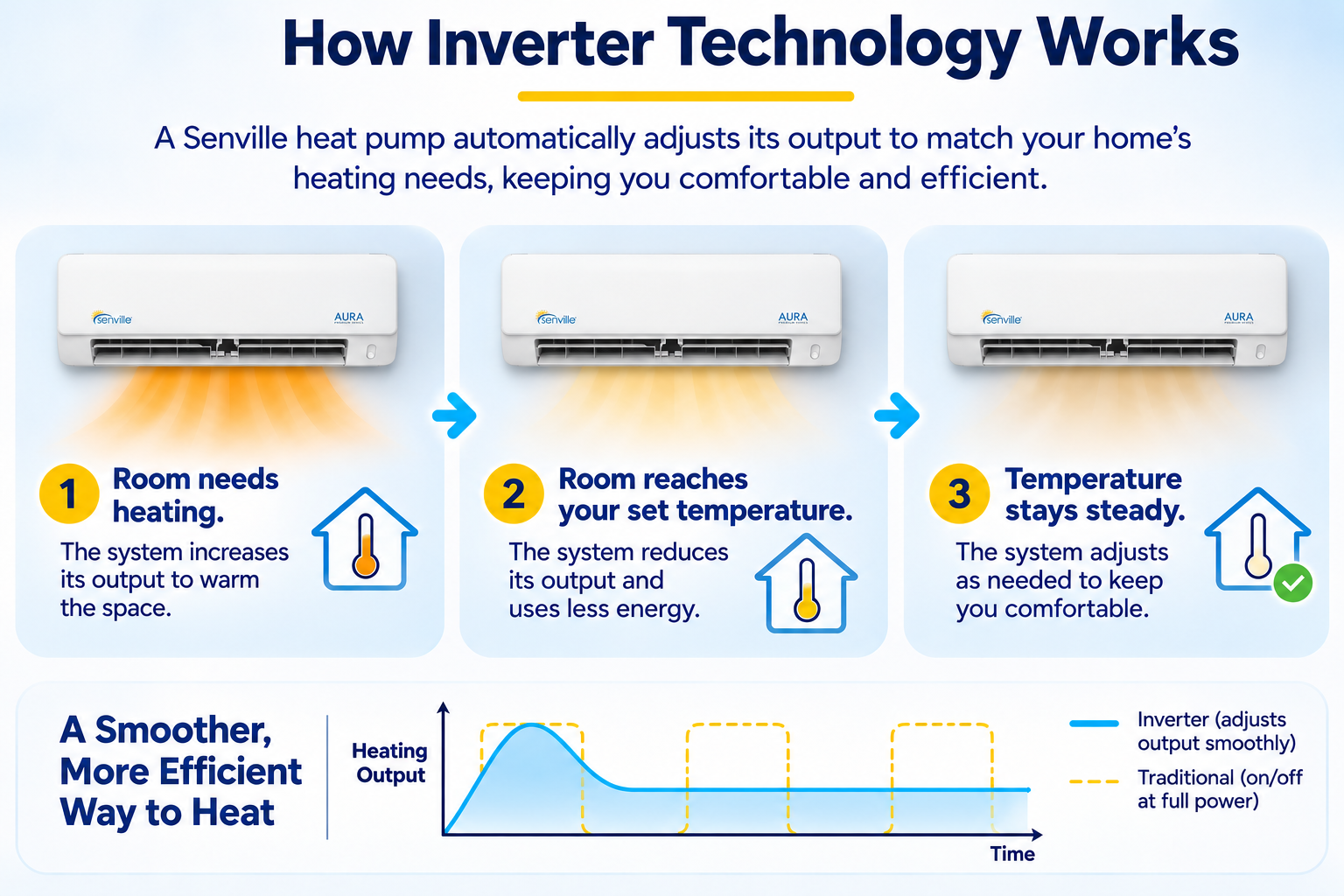
Imagine setting your Senville mini split to 21°C on a cold winter morning.
When you first turn it on, the system may operate at a higher output to bring the room toward your desired temperature.
As the room approaches 21°C, the compressor can slow down and reduce its output.
Rather than repeatedly running at maximum capacity, the system adjusts to maintain comfort as conditions change.
This variable-speed operation can help improve efficiency and maintain more consistent indoor temperatures.
Does This Mean the Compressor Never Stops?
Not necessarily. Even inverter-driven heat pumps may cycle off under certain conditions, depending on the model, operating mode, temperature demand, and system controls.
The important point is that they're designed to adjust their output and operate for extended periods when heating or cooling is needed.
Why Does This Matter During a Canadian Winter?
In places like Ontario, Quebec, Alberta, and Manitoba, outdoor temperatures can drop significantly overnight.
If you switch off your heat pump and allow your home to cool considerably, the system may need to work harder and longer to restore your preferred temperature.
A large temperature setback may also increase the need for supplemental heating, depending on how your home is heated.
For many households, maintaining a relatively steady temperature offers a comfortable and practical alternative.
2. Should You Leave Your Heat Pump On, Turn It Down, or Switch It Off?
Not every situation calls for the same approach.
Use this quick reference to help decide what makes sense for your home.
| Situation | Recommended Approach | Why |
|---|---|---|
| Normal day at home | Leave it running at a steady temperature | Helps maintain consistent comfort |
| Overnight | Keep it on; consider a 1–2°C setback | Allows a slightly cooler sleeping temperature without a large recovery |
| Away at work for 8–10 hours | Keep it on or use a small setback | Helps avoid significant indoor temperature drops |
| Away for several days in winter | Maintain a safe heating temperature | Helps reduce the risk of freezing and moisture problems |
| Away during mild spring or fall weather | Turn it off if heating or cooling isn't needed | Avoids unnecessary operation |
| Room you rarely use | Reduce heating or turn off that zone when appropriate | Limits conditioning of unused spaces |
| Cleaning or maintenance | Turn off the unit and isolate power as instructed | Helps ensure safe maintenance |
These are general guidelines rather than fixed rules.
Your ideal settings will depend on your home's layout, insulation, outdoor conditions, and how your heat pump interacts with other heating equipment.
Important: During winter, don't assume a low setting such as 15°C will adequately protect every home from freezing. Plumbing in exterior walls, basements, crawl spaces, or poorly insulated areas may need additional protection. Consult a qualified HVAC professional before choosing an extended-absence setting.
3. Does Leaving a Heat Pump On All the Time Use More Electricity?
This is one of the most common questions homeowners ask.
If your heat pump runs throughout the day, wouldn't that automatically increase your electricity bill?
Not necessarily.
A heat pump's electricity consumption depends on how much heating or cooling it needs to provide, not simply how many hours it's switched on.
Steady Temperatures vs. Large Setbacks
When your heat pump maintains a relatively consistent indoor temperature, its inverter compressor can adjust its output to match the home's heating needs.
If you turn the system off for several hours, the indoor temperature may fall.
While turning it off reduces electricity consumption during that period, the system must later restore the lost heat.
The overall savings depend on several factors, including:
- Outdoor temperature
- Home insulation and air leakage
- Heat pump efficiency and available heating capacity
- Duration and size of the temperature setback
- Whether supplemental heating is required
- Local electricity rates and time-of-use pricing
For example, a well-insulated home in southern Ontario may respond differently from an older home in northern Quebec during a cold snap.
Can Turning the Temperature Down Save Money?
Yes, moderate setbacks can reduce heating demand.
However, deep setbacks aren't always the most economical approach for heat pumps, particularly when they trigger supplemental electric resistance heating during recovery.
Natural Resources Canada recommends minimizing heat pump setbacks and generally keeping them to no more than 2°C, unless an appropriate control strategy is in place.
The goal is to balance comfort, efficiency, and the heating requirements of your home.
Senville Tip: If your electricity bill seems unusually high, review more than your temperature setting. Dirty filters, blocked airflow, poor insulation, and incorrect equipment sizing can all affect heating performance.
If you're considering a new system, explore Senville's mini splits by room size as a starting point, then consult a qualified installer for proper sizing.
4. Should You Turn Your Heat Pump Off at Night?
For most Canadian homeowners using a heat pump as their primary heating source, keeping it on overnight is generally recommended during winter.
This helps maintain a more consistent indoor temperature and avoids a large heating demand the following morning.
What If You Prefer a Cooler Bedroom?
You don't necessarily have to maintain the same temperature all night.
For example, if you normally keep your home at 21°C, you might try lowering the setting to 19–20°C overnight.
A small adjustment can make your sleeping space more comfortable without allowing the room to cool dramatically.
What About Sleep Mode?
Many Senville mini splits include a Sleep function.
On compatible models, this feature adjusts temperature settings over time to support nighttime comfort.
The exact behaviour depends on the model and operating mode, so consult your owner's manual before relying on it for a specific temperature schedule.
Should You Turn Your Heat Pump Off at Night in Summer?
Summer is different because your system is cooling rather than heating.
If you prefer a warmer sleeping temperature, you can raise your cooling setpoint slightly.
Whether you leave the system running overnight depends on indoor humidity, outdoor temperatures, and your comfort preferences.
Bottom line: During Canadian winters, a small nighttime setback is generally preferable to switching off a heat pump that's responsible for keeping your home warm.
5. What Are the Best Heat Pump Settings for Everyday Use?
The right settings depend on the season and your comfort needs.
Here are five practical ways to get started.
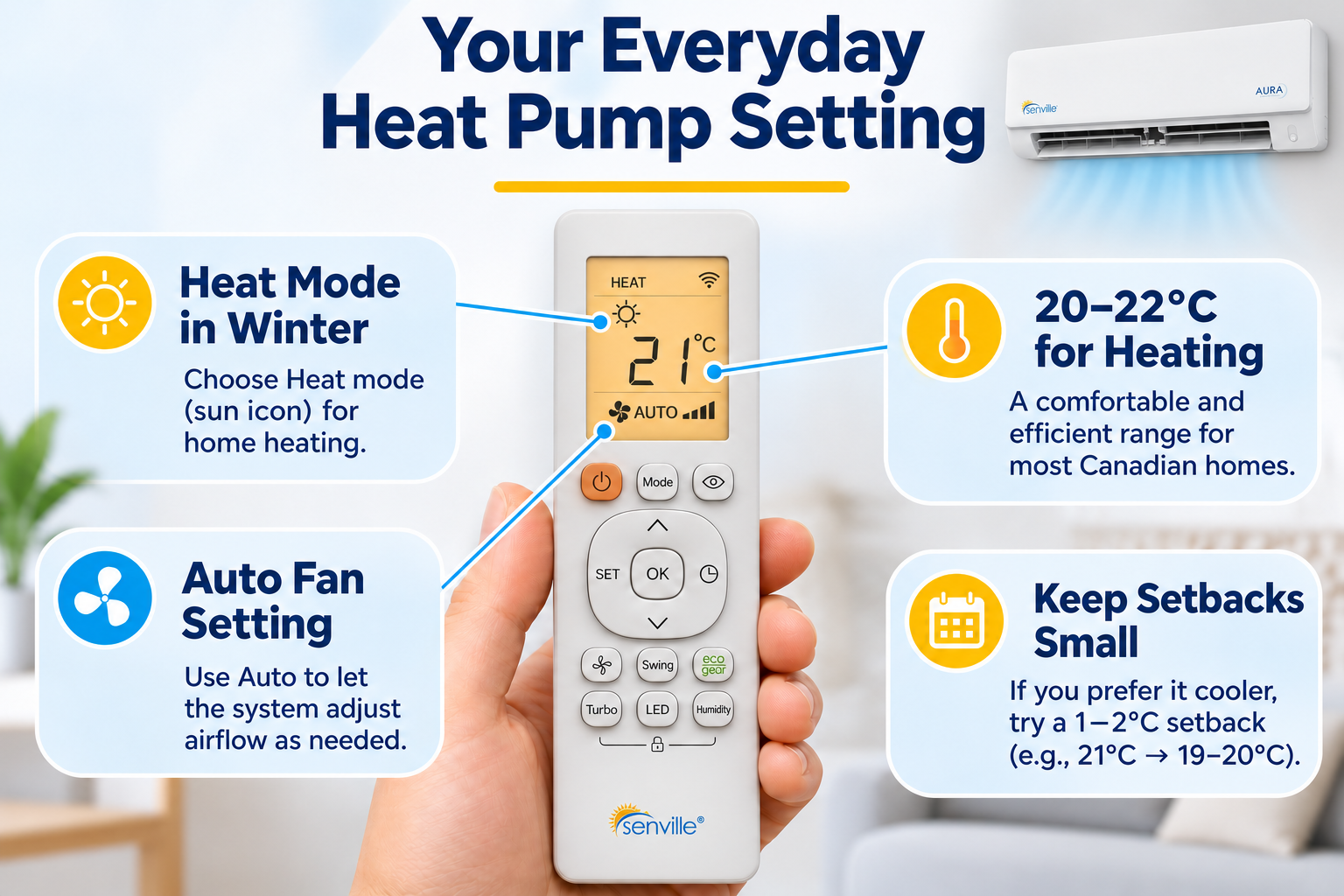
1. Choose Heat Mode in Winter and Cool Mode in Summer
For consistent seasonal operation, select Heat mode when you want heating and Cool mode when you want cooling.
On most Senville remotes, the sun symbol represents Heat mode and the snowflake represents Cool mode.
Auto mode may automatically switch between heating and cooling on compatible systems.
If you want your mini split to remain in one operating mode throughout the season, selecting Heat or Cool directly is usually simpler.
2. Choose a Comfortable Temperature
As a general starting point, consider:
| Season | Example Temperature Setting |
|---|---|
| Winter heating | 20–22°C |
| Summer cooling | 23–25°C |
| Overnight winter heating | Approximately 1–2°C below your daytime setting, if preferred |
These are examples, not mandatory settings.
Your ideal temperature depends on your preferences, insulation, humidity, and how heat moves through your home.
3. Adjust Your Fan Setting
Auto fan mode allows compatible systems to adjust airflow based on operating conditions.
During heating, a higher fan speed may also help distribute warm air more effectively through the space.
Choose a setting that balances comfort, airflow, and noise.
4. Avoid Frequent, Large Temperature Changes
Rather than constantly raising and lowering the setpoint, choose a comfortable temperature and give the system time to maintain it.
If you use a setback, keep it modest during colder weather.
5. Explore Wi-Fi Controls and Scheduling
Depending on your Senville model and compatible Wi-Fi accessory, app-based controls may allow you to adjust your system remotely.
Some compatible configurations also offer scheduling features.
For example, you may be able to adjust the temperature before arriving home rather than leaving the system at a higher setting all day.
Explore Senville's Wi-Fi-enabled heat pump options and confirm the available app features for your exact model.
Popular options to explore include the LETO 12,000 BTU Mini Split and the AURA 12,000 BTU Cold-Climate Mini Split.
6. Should You Leave Your Heat Pump Running During Extreme Cold?
If you're experiencing a Canadian cold snap, maintaining a steady indoor temperature becomes especially important.
During extremely cold weather, your home loses heat more quickly, and your heat pump may have less available heating capacity than it does during milder conditions.
This is why cold-climate performance matters when selecting a system.
What About Senville AURA Heat Pumps?
Senville's AURA Series is designed for cold-climate heating and cooling.
Select AURA models are rated to operate in heating mode at outdoor temperatures as low as -30°C.
However, the minimum operating temperature doesn't mean the system delivers its full rated heating capacity at that temperature.
Actual heating performance depends on the specific model, outdoor conditions, equipment sizing, and installation.
Cold-Climate Tips for Canadian Homeowners
During a cold snap:
- Keep your heat pump at a relatively steady heating temperature.
- Avoid large overnight setbacks.
- Check that indoor filters are clean.
- Keep snow and debris away from outdoor air inlets and outlets.
- Allow normal defrost cycles to finish.
- Make sure your supplemental heating strategy is appropriate for your home.
If your system can't maintain the desired indoor temperature, contact a qualified HVAC professional to assess heating capacity and any potential equipment issues.
Cold Climate Tip: In regions such as the Prairies, Northern Ontario, and Quebec, choosing the right cold-climate heat pump and maintaining consistent winter settings can make a meaningful difference in comfort.
For more homeowner tips, read 7 Common Heat Pump Mistakes Homeowners Make.
7. When Should You Switch Your Heat Pump Off?
Although keeping a heat pump running is often recommended during the heating season, there are situations where turning it off makes sense.
When Heating or Cooling Isn't Needed
During mild spring or fall weather, you may not need active heating or cooling.
If indoor temperatures remain comfortable and your home doesn't require freeze protection, you can switch off the system.
When a Room Isn't Being Used
If you have a multi-zone system, you may be able to reduce conditioning in rooms that aren't regularly occupied.
For example, a Senville dual-zone mini split system allows compatible indoor units to have individual temperature settings.
However, turning off one indoor unit doesn't necessarily eliminate all energy use associated with that zone or the outdoor system.
You should also consider whether the unused room contains plumbing or needs heating to prevent moisture or freezing problems.
Before Cleaning or Maintenance
Always turn off your mini split before cleaning its filters.
Follow your owner's manual for any additional power-isolation instructions.
For servicing involving internal electrical components, refrigerant, or other technical repairs, contact a qualified HVAC professional.
If You Notice a Possible Equipment Problem
Turn off the system and seek professional assistance if you notice:
- Persistent or recurring error codes
- Unusual grinding or other concerning mechanical noises
- Water leaking in an unexpected location
- Burning smells or signs of electrical trouble
- Excessive ice buildup that doesn't clear during normal defrost operation
Don't attempt to repair refrigerant or electrical components yourself.
8. What If You're Going Away for Several Days in Winter?
If you're leaving home for a winter vacation, switching off your heat pump completely may not be appropriate.
Even if nobody is home, your house may still require heating to protect plumbing, prevent excessive indoor cooling, and manage moisture.
Should You Set Your Heat Pump to 15°C?
A reduced temperature may be appropriate for some homes, but 15°C isn't a universal freeze-protection setting.
The right temperature depends on your home's construction, plumbing locations, insulation, local weather, and backup heating arrangements.
An indoor unit's temperature sensor may also read a warmer temperature than a distant room, basement, or exterior-wall cavity.
Before leaving for an extended period in freezing weather:
- Confirm an appropriate minimum heating temperature with your HVAC professional.
- Check whether supplemental heating is needed.
- Ensure the outdoor unit has adequate clearance from snow and ice.
- Consider reliable temperature monitoring and a plan for power outages.
- Review your home insurance requirements for winter absences.
Some compatible Senville systems offer a Freeze Protection function, but its availability and operating behaviour vary by model.
Important: Don't assume that a low-temperature function alone provides complete protection for your entire home.
9. Frequently Asked Questions
Is It Bad to Run a Heat Pump 24/7 in Winter?
No. Modern inverter-driven ductless heat pumps are designed to operate for extended periods when heating is needed. Maintaining a steady temperature is often a good approach during winter. Keep filters clean and outdoor airflow unobstructed.
Is It Cheaper to Leave a Heat Pump On or Turn It Off?
It depends on the weather, home insulation, system efficiency, and how long the heat pump would be off. During daily winter use, maintaining a steady temperature can help avoid long recovery periods. Moderate setbacks may also save energy, but deep setbacks can increase reliance on supplemental heating.
How Much Should I Turn My Heat Pump Down at Night?
If you prefer a cooler room, try lowering the heating setpoint by approximately 1–2°C. Natural Resources Canada generally recommends limiting heat pump setbacks to no more than 2°C unless a suitable control strategy is used.
Should I Leave My Heat Pump On When I Go Away in Winter?
If your home needs freeze protection, maintain an appropriate heating temperature rather than switching off all heating. The correct setting depends on your home's plumbing, insulation, backup heating, and local conditions. Consult a qualified professional before an extended winter absence.
Should I Use Auto Mode on My Heat Pump?
For predictable seasonal operation, choose Heat mode during winter and Cool mode during summer. Auto mode may switch between heating and cooling on compatible systems, depending on room conditions and system controls.
Does Switching a Heat Pump On and Off Damage It?
Normal on/off operation is part of how heat pumps are designed to function. However, repeatedly switching the system off and on manually isn't usually necessary for everyday comfort. Let the system's controls manage its operation according to your temperature setting.
Can I Leave My Mini Split On All Day While I'm at Work?
Yes. During winter, leaving it running at a steady temperature is often a practical option. You can also try a small setback if appropriate for your home and heating system.
Should I Turn My Heat Pump Off in the Summer?
Not necessarily. If cooling is needed, you can maintain a comfortable temperature or use a higher cooling setpoint while away. If outdoor conditions are mild and cooling isn't required, switching it off may reduce electricity use.
10. Find the Right Balance of Comfort and Efficiency
So, should you leave your heat pump on all the time?
For many Canadian homeowners, keeping a ductless heat pump running at a relatively steady temperature during the heating season is a practical approach.
Inverter technology allows the system to adjust its heating output as conditions change, helping maintain consistent comfort without requiring frequent manual adjustments.
Small temperature setbacks may be useful, but large changes can lead to longer recovery periods, particularly during cold weather.
The best strategy is to choose comfortable settings, understand your system's capabilities, and adjust your routine based on your home's heating needs.
And if you're shopping for a new heat pump, choosing the right system for your space and Canadian climate is just as important as how you operate it.
Explore Senville's Wi-Fi-Enabled Heat Pumps
Looking for more control over your home's heating and cooling? Explore Senville's compatible Wi-Fi-enabled mini split systems and accessories to learn how you can adjust your comfort settings from your phone.
Shop Senville Wi-Fi-Enabled Heat PumpsSenville Products & Resources Mentioned
- AURA 12,000 BTU Mini Split Heat Pump — Cold-climate heating and cooling, with model-specific performance specifications.
- AURA 18,000 BTU Mini Split Heat Pump — An option for larger spaces when properly sized.
- LETO 12,000 BTU Mini Split Heat Pump — Heating and cooling for applications suited to its operating range.
- Dual-Zone Mini Split Systems — Individual temperature settings for compatible indoor units.
- Wi-Fi-Enabled Heat Pumps — Explore compatible connected-control options.
Additional Resource
Natural Resources Canada: Heating and Cooling With a Heat Pump
Disclaimer: The information in this article is provided by Senville for general informational purposes only and does not constitute professional HVAC, electrical, or safety advice. Heating performance, temperature settings, equipment capabilities, and maintenance requirements vary by model and installation. Consult your system's manuals, applicable local requirements, and a qualified HVAC professional before making installation, repair, servicing, or freeze-protection decisions. Do not rely on a heat pump setting alone to protect a property from freezing during an extended absence.